AI for Game Development Unreal Engine 5: Development Cost, Features & Timeline
Key Takeaways
- UE5 AI can range from basic NPC behavior to advanced ML-driven systems, depending on the gameplay scope.
- Behavior Trees, EQS, Mass AI, and ML Deformer support smarter NPCs, crowds, and character animation.
- Costs increase with AI complexity, especially for ML models, large-scale simulations, and custom data pipelines.
- Timelines can range from weeks to several months, depending on the level of AI integration.
- Early AI planning helps reduce rework and improves performance, scalability, and long-term maintainability.
Introduction
The AI toolkit for Unreal Engine 5 has advanced significantly since pre-set enemy patrols. Behavior Trees are now used in conjunction with Mass AI crowd simulation, ML Deformer character animation and perceptual systems that enable NPCs to see, hear and react in realistic ways. Studios are exploring the use of AI for Game Development Unreal Engine 5. Users are no longer wondering if these systems work, they want to know how much they cost, how long they take, and which features actually move the needle for a given project. This guide delves into the fundamental artificial intelligence systems within UE5, presents realistic cost estimates for various AI complexity levels, outlines a phase-by-phase development timeline, and lists the questions to ask before engaging with a studio.
What Is AI Game Development Unreal Engine 5?
In Unreal Engine 5, AI game creation is about using Epic’s native AI framework to build non-player character logic, spatial reasoning and animation systems, rather than writing your own scripts. The Behavior Tree is the node-based system that powers decision making, and the Blackboard is the data that those decisions are made upon – player location, health, last known position, etc. The Environment Query System (EQS) takes this a step further by allowing an AI to query its surroundings, scoring things like cover points, flanking paths, or item locations, which are then used by a Behavior Tree. At the core of it all is the Navigation Mesh, which defines the walkable surface an AI Controller uses to navigate to a destination.
In one important way this differs from traditional scripting, however: rather than hard-coding “if player is visible, chase”, designers create modular tasks, decorators, and services that can be reused and tweaked without changing the code. You get scalable Unreal game development, where the same Behavior Tree framework can control a single patrolling guard or hundreds of coordinated units. Most UE5 AI implementations are based on Epic’s own Environment Query System documentation, which describes how generators, contexts, and tests work together to produce these weighted judgments.
Core AI Features in Unreal Engine 5
The UE5 AI stack consists of six basic subsystems, each dealing with a different aspect of NPC intelligence. Here’s what each system does and how they interact:
- Behavior Trees: The foundation of NPC decision-making. Composite nodes handle branched logic, decorators control execution based on conditions and services modify values on the Blackboard on a timer. One tree structure can fuel one patrol guard or hundreds of coordinated troops.
- Blackboard: Shared memory storage for player location, health and last known position, which Behavior Tree nodes use to make decisions. The structure of the Blackboard keys determines the maintainability of an AI system as it gets more complex.
- Environment Query System (EQS): Provides spatial reasoning. Instead of a hard-coded location, an AI could ask “where is the nearest cover point with line of sight to the player” and get back a scored answer using Generators, Contexts, and Tests.
- Navigation Mesh: This is the surface that the AI Controller can walk on to reach a destination. Recast-based pathfinding keeps mobility grounded and collision-aware in dynamic, destructible settings.
- Perception System: Layers sight, hearing and damage stimuli, so that an NPC’s awareness is based on what it can actually sense, not what the designer thinks it should know.
- Mass AI: A data driven architecture for crowds that removes the overhead of individual actor Behavior Trees. Uses ZoneGraph navigation, State Tree behavior scripting and Smart Object interactions to simulate thousands of agents at the same time without sacrificing frame rate.
- ML Deformer: Real-time High-Fidelity Character Deformation Estimation from Offline Muscle, Flesh and Cloth Simulation Data The required raw material is a well-topologized 3D character design, and the quality of the deformation is constrained by the base mesh in an independent manner from the training data. Naturally extends to 3D animation production, capturing secondary motions like muscle bulge and textile response without hours of tedious keyframing.
These systems do not operate independently of each other. A good implementation also employs more general machine learning approaches to train and validate the underlying models before they are used in a production build. The documentation of the Epic’s ML Deformer Framework documentation describes the training method in detail, including how to produce the offline simulation data that teaches the model.
Cost Breakdown: What Drives UE5 AI Development Cost
The cost scales with the intelligence of the AI, not the number of NPCs . A basic patrol-and-chase enemy using a single Behavior Tree, some Blackboard keys, and Navigation Mesh pathing is a pretty straightforward engineering task. Fully ML-driven systems require data pipelines, training iteration and much more stringent QA, which significantly increases the budget. Here’s the cost breakdown by complexity tier:
Simple single-enemy AI with basic Behavior Trees, a few Blackboard keys, and standard Navigation Mesh pathing is often in the low five figures (USD). This tier contains a few enemy archetypes with patrol, chase and attack states – enough for a linear level or limited combat encounter. Engineering is simple, QA surface is modest. This is the most predictable cost band.
Mid-complexity systems include EQS for spatial reasoning, many AI states beyond basic combat (alert, investigate, retreat), and the Perception component for sight and hearing. This grade usually costs in the mid five digits. The price hike is due to 3 sources: EQS set-up and tuning, Perceptual configuration for a multitude of stimulus types, QA expansion that is needed when AI behavior is context-dependent instead of scripted.
Full ML-driven systems – mass AI crowds with layered decision logic, trained ML Deformer models, perception-driven squad tactics, or custom models – cost six figures, depending on scope. This layer requires data pipelines for training, iteration cycles for model refinement, and a much more robust QA pass as behavior becomes probabilistic instead of deterministic. In the ML Deformer, training-data acquisition, model training and real-time inference integration are all separate costs.
Adjacent Line Items That Add to the Budget
It’s also worth thinking about the overall cost of developing Unreal Engine 5 AI games in terms of the extra features that certain studios add. Generative AI content pipelines for dialog variation, ambient barking, and texture variation at scale can be built orders of magnitude faster than manual asset passes, but still require human approval. Behavior Tree logic already dictates how characters move and fight, and AI chatbot development for conversational NPC systems adds natural-language processing to the mix. The AI-in-games industry is projected to grow at a CAGR of roughly 40.7% through 2030 according to Technavio’s independent analysis. AI features are no longer an optional polish, but rather a typical line item in UE5 budgets.
Need a Clear Budget for Your UE5 AI Game?
Development Timeline
A typical AI implementation consists of five steps, each building on the previous one. If you rush the design step you will tend to lose time later on when you have to restructure Behavior Trees based on Blackboard keys you did not plan for. Here’s the timeline broken down by phase and difficulty level:
Phase 1: AI Architecture and System Design
This is where the team figures out what AI tools are needed for the project and if EQS is needed, how many Blackboard keys will be used to drive decision making, and if Mass AI or ML Deformer are in the scope. The Architecture decisions made here will determine all future Cost and Timeline variables. Behavior Trees often need to be restructured around keys that were not anticipated. Studios who skip or compress this phase to meet a sprint deadline often pay the price in rework.
Phase 2: Behavior Implementation
This stage involves behavior trees, blackboard setup, EQS setup and navigation mesh tuning. This is a manageable engineering challenge for a simple single-enemy archetype with states of patrol, chase and attack. In terms of the different types of enemies and squad coordination based on perception, this phase is greatly extended since each archetype has its own tree, decorator logic, and Blackboard key schema.
Phase 3: ML Integration (Where Applicable)
If ML Deformer, Mass AI crowds or generative dialog are in play, this phase takes up most of the timetable. Training data collection (e.g. muscle, flesh and cloth simulation data for ML Deformer, or crowd agent behavior data) can not be compressed. Model training and iteration cycles have their own schedules and each iteration needs to be validated before going to production.
Phase 4: Testing Against Edge Cases
AI behavior is probabilistic when ML is involved, so testing must include edge cases that deterministic scripted logic never sees: pathing into geometry, perception checks firing at the wrong range, stranded states after level geometry changes, crowd agents colliding during high-density events. Pre-production quality assurance planning pays off there: catching these flaws in development costs a fraction of certification.
Behavior trees, EQS queries, and ML inference all require CPU and GPU resources. Optimization is about making sure the AI runs at the target frame rates on the game’s minimum spec hardware, not the developer’s high end workstation. The performance profiles of both the Mass AI and the ML Deformer are to be tested at scale, not only in a test environment.
Timeline by Complexity Tier
- Basic NPC AI: From design to a polished, playable build, the basic NPC AI takes about 4 to 8 weeks. An enemy archetype with Behavior Trees and a simple Navigation Mesh that goes through states of patrol, chase and assault.
- Full ML-Driven AI: 6 to 12 months. Trained ML Deformer models, mass AI crowd behavior, and perception-based squad coordination. The majority of the schedule is consumed by training data collection and iteration cycles, not core engineering activity.
How AI Integration Affects the Wider Project Timeline
The total project impact of AI integration in Unreal Engine 5 depends on when it will be integrated. Getting AI architectural decisions during pre-production means less rework when you put Behavior Trees onto systems that weren’t designed to support them. If your team is coming from a Unity game development workflow you should expect some extra ramp-up time. There is no equivalent for EQS and Mass AI in Unity, so even engineers that understand the concept of Behavior Trees will have a steep learning curve.
See Smarter NPCs and AI-Driven Gameplay in Action
Use Cases – Where AI in UE5 Delivers the Biggest Impact
The most valuable apps are clustered into six domains, each building on the same core AI stack but in a different way. Here’s how each use case works and what measurable benefit it provides.
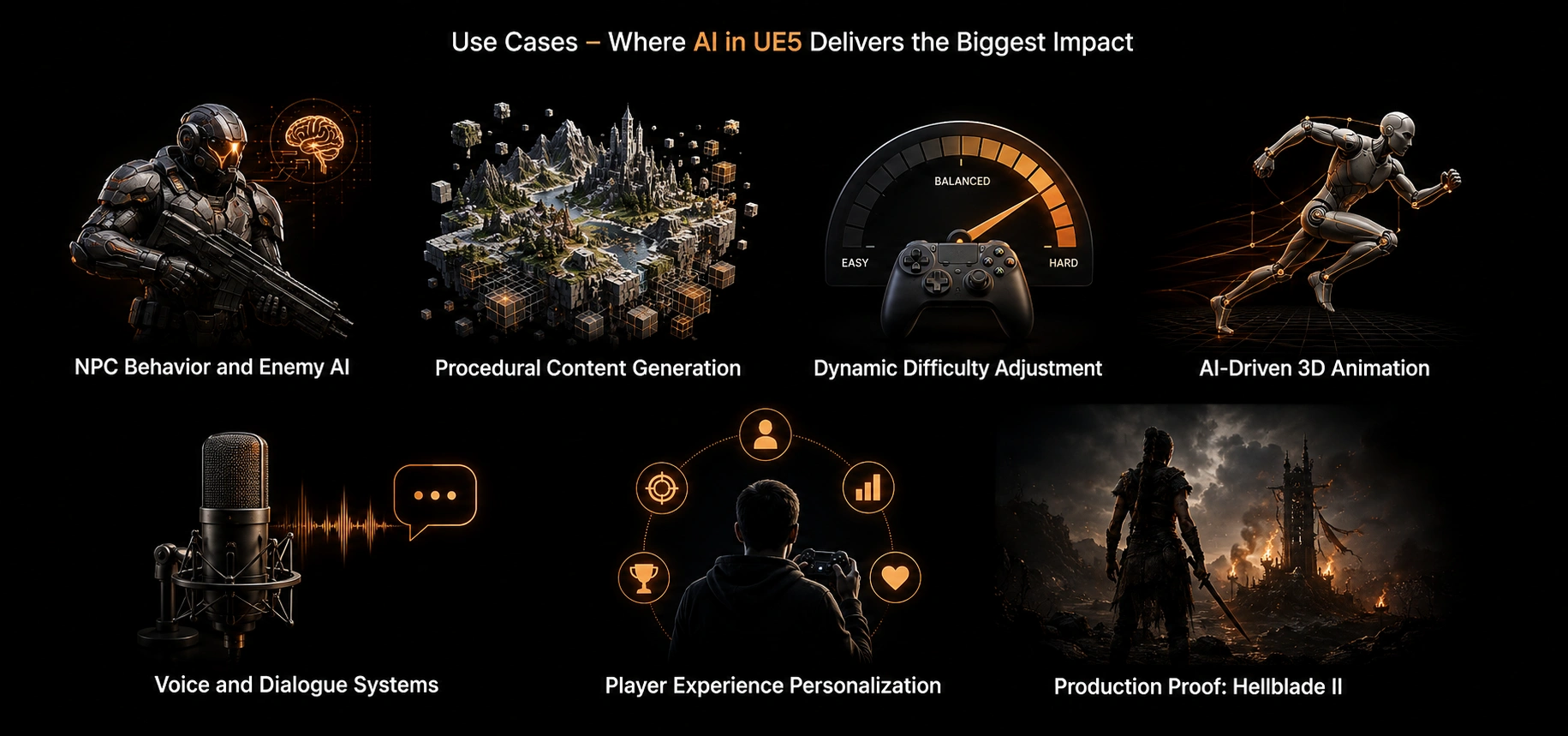
1. NPC Behavior and Enemy AI
Behavior Trees and EQS are the most common entry points that instantly improve combat experience with limited scope. AI enemies that take cover, flank and coordinate using Blackboard driven logic seem less scripted than hard-coded patrol paths, and the tree structure used can be reused across different enemy archetypes, reducing per-enemy implementation time as the project grows. This is the least risky way to integrate UE5 AI, studios can begin here without needing a commitment to an ML pipeline.
2. Procedural Content Generation
Artificial intelligence can populate levels, loot tables and encounter variation without having to place each instance. We can use EQS queries to know where an adversary should spawn based on cover density and sight lines . Blackboard-driven logic can be used to adjust encounter composition based on player progression . This greatly increases the amount of content that can be generated compared to hand authoring each room, and is especially helpful for rogue likes or open-world titles where volume of content is a major feature, not just an afterthought.
3. Dynamic Difficulty Adjustment
By reading player performance signals (hit accuracy, time to complete encounters, resource consumption) and adjusting encounter pacing in real time, players are kept engaged, rather than annoyed or bored. This is a use case closely tied to player retention, as difficulty that adapts to observed behavior keeps new and veteran players engaged for greater lengths of time.
4. AI-Driven 3D Animation
ML Deformer and motion-matching techniques give you higher visual fidelity, but without requiring more animator hours. The ML Deformer adds secondary motion such as muscle bulging, textile reactions, and flesh deformation that would take an animator hours per shot to replicate by hand. For studios making character-heavy games, this is the best AI investment in visual quality per dollar. It works best in concert with well-topologized 3D animation processes. The learned deformation supports key framed work, not a total replacement.
5. Voice and Dialogue Systems
Context-aware NPC replies can be enabled by generative models and the Perception system, where an NPC that can see the player approaching from a distance, has a conversation that is relevant to the current game state, and reacts differently based on what it has “seen” or “heard”. This is the area where the development of AI chatbots and generative AI come closest to the native systems in UE5. The handling of natural language is built on top of character states driven by Behavior Trees.
6. Player Experience Personalization
Adapting tempo, hints, or content recommendations to individual play habits links several artificial intelligence systems together. The player who rushes through encounters will have a different rhythm than the player who explores carefully, and contextual hints are given to the player who is stuck on a challenge. This is where studios see the most obvious retention benefits, because a personalized pace keeps players engaged longer, and limits the mid-game drop-off that many games struggle with.
Production Proof: Hellblade II
Ninja Theory’s work on Senua’s Saga: Hellblade II is a useful benchmark: the studio built its facial animation and character work directly on Unreal Engine 5, leveraging engine-native tooling to deliver a level of real-time fidelity that would have been impossible to achieve through manual animation alone, as noted in an interview with GamingBible. That’s a reminder that these artificial intelligence systems are now in commercial products, not just tech demos. And it’s a reminder that the studio’s investment in engine-native AI animation paid off with character fidelity that set a new standard for real-time rendering.
Choosing an Unreal Engine Game Development Partner
What matters more than a list of features is a track record. Ask the Unreal Engine game development company you are thinking of hiring to show you a Behavior Tree they have made for an actual project, one that is completed or near completion, not just a prototype. Ask about their maintainability structure for Blackboard keys, if they’ve shipped Mass AI at scale, and if their ML Deformer knowledge includes actual training-data pipelines or just sample-project familiarity.
A good Unreal engine game development services partner should also be upfront about cost and schedule trade-offs instead of giving a single price for “AI”. Any studio providing these services should have NPC AI or crowd-simulation work in their portfolio, along with supporting disciplines like game development, QA and animation. For an academic background on how these architectures stack up, the Springer Nature analysis of LLM integration in Unreal Engine 5 NPCs is a good technical reference, and independent 2026 game development industry statistics provide broader cost context.
Concluding Note
UE5’s AI stack (Behavior Trees, Blackboard, EQS, Navigation Mesh, Mass AI, and ML Deformer) allow studios to create game-ready NPCs, crowds, and animations. But it is necessary to make realistic expectations from the beginning. Costs and schedules vary greatly depending on how far a project ventures into ML-driven territory, so treat each figure here as a planning estimate rather than a quote. Studios weighing AI for Game Development Unreal Engine 5 are best served by partners who can show shipped work, not just engine familiarity. Studios that scope AI correctly from pre-production can ship smarter games within budget.
Frequently Asked Questions
1. What is AI for Game Development Unreal Engine 5?
Unreal Engine 5 features Epic’s AI framework, which consists of Behavior Trees for decision-making, Blackboard for data, EQS for spatial scoring, Navigation Mesh for pathfinding, Mass AI for crowds, and ML Deformer for character animation.
2. What are the core AI features in Unreal Engine 5?
Unreal Engine 5 comes with seven subsystems that are responsible for the core AI capabilities: Behavior Trees, Blackboard, EQS, Navigation Mesh, Perception System, Mass AI, and ML Deformer. Each solves a specific problem: decision making, data storage, spatial reasoning, pathfinding, sensory awareness, crowd simulation, real time deformation of characters
3. How much does Unreal Engine 5 AI game development cost?
Basic NPC AI is in the low fifty’s. Mid-complexity systems, EQS, perception cost in the mid five digits. Complete artificial intelligence driven by ML including Mass AI and ML Deformer can run into six figures. The number of NPCs increases costs as well as the intelligence of the AI.
4. How long does AI integration in Unreal Engine 5 take?
Basic NPC AI – 4-8 Weeks. Most of the timeline is taken up by training data collection and model iteration cycles, so full ML-driven systems are six to twelve months in the making. If you’re coming from Unity, you should expect a bit of a learning curve.
5. What are the most impactful AI use cases in UE5?
Features include NPC and enemy AI behavior, procedural content generation, dynamic difficulty adjustment, AI-driven 3D animation using ML Deformer, voice and dialog systems and personalized player experiences. The biggest retention wins are from adaptive pacing and tailored difficulty.
6. How do I choose an Unreal engine game development company for AI work?
Request completed projects that utilize Behavior Trees, EQS and Mass AI, NOT demos. Validate Blackboard key structuring, Mass AI scale experience, ML Deformer training-data pipelines. A good partner will not give you a number but will be transparent about the trade-offs between cost and time.
Ready to Plan AI for Your Unreal Engine 5 Game?